
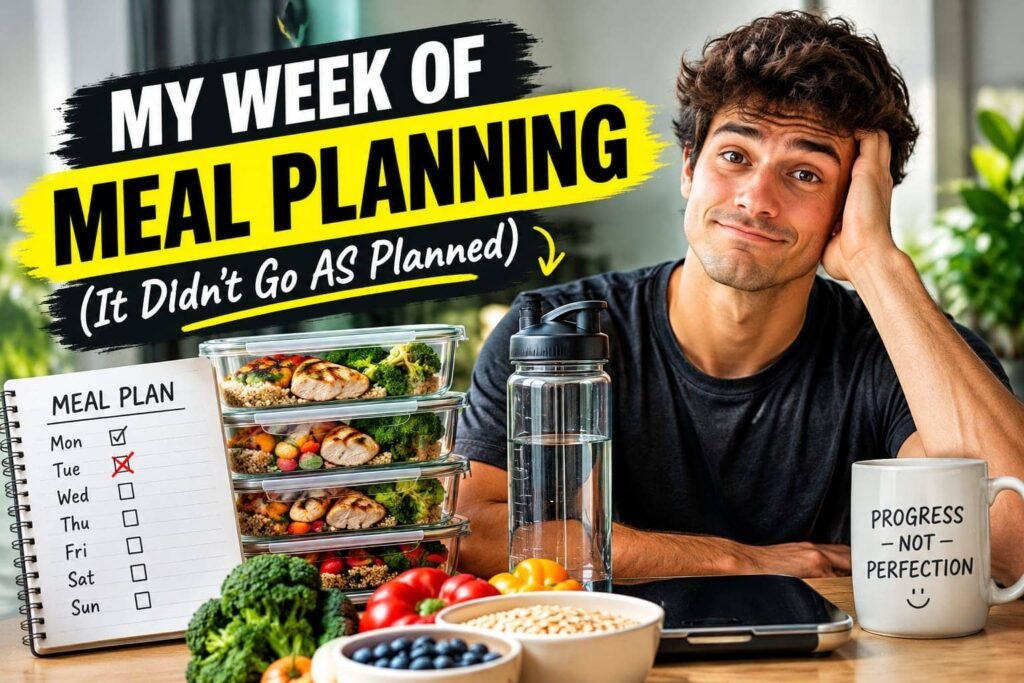
My first real meal plan was a masterpiece. A color-coded spreadsheet, every meal assigned a slot, calories calculated to the decimal. I felt like a person who had finally figured out adulthood.
It lasted until Tuesday.
A meeting ran late, and I got home at 8 pm. The grilled chicken and quinoa bowl waiting in my fridge felt like a punishment. I ordered noodles instead. By Wednesday, the spreadsheet was a guilty tab I kept avoiding, and by the weekend, I’d quietly abandoned my meal plan for weight loss.
That cycle repeated for about a year. Strict plan, perfect for three days, collapse, guilt, restart. The scale went up and down by the same five pounds, and I started to suspect I was the problem.
I wasn’t. The plans were. They were built for a version of me with endless energy and zero surprises. Real weeks have late meetings, tired evenings, and a friend’s birthday dinner nobody planned for.
What finally worked was a looser setup that I’ve now used for well over a year. It’s not exciting, but it holds up on a bad Tuesday. Here’s exactly how I do it, mistakes included.
A quick note before we start
I’m not a doctor or a dietitian. This is what worked for me as an ordinary adult trying to manage my weight sustainably, and your body, health, and goals might call for something different.
If you have diabetes, an eating disorder history, a heart or kidney condition, are pregnant or breastfeeding, or take medication that interacts with food, please talk to your doctor or a registered dietitian before changing how you eat. That’s not a throwaway line. A plan that’s fine for me could be wrong for you.
What “weight management” actually meant for me

I used to hear “weight management” and think “diet.” Those aren’t the same thing.
A diet has an end date. Weight management is the longer game: eating in a way that lets your weight stay roughly where you want it, without feeling like you’re serving a sentence.
For me, the goal wasn’t a dramatic number. It was getting down about 12 pounds, then staying there without constant effort. That changed how I built meals. Instead of asking “what’s the lowest-calorie option?”, I started asking “can I eat this way on a normal week, forever?”
If the answer was no, the plan was wrong.
The four rules my plan runs on
After a lot of trial and error, my whole approach boiled down to four simple ideas. I don’t count every bite, but these keep me on track.
1. Protein at every meal. It keeps me full longer. When I eat a carb-heavy breakfast with no protein, I’m hungry by 10:30. When I add eggs or yogurt, I’m fine until lunch.
2. Half the plate is vegetables (most of the time). Not a strict rule, more of a default. It adds volume without adding many calories, and it keeps meals from feeling tiny.
3. A filling carb, but a sensible portion. I’m not afraid of rice, potatoes, or bread. I just stopped eating them in bottomless bowls.
4. Repeat meals on purpose. This is the secret nobody wants to admit. I eat the same three or four breakfasts and lunches on rotation. It takes decision-making out of the picture, and decision fatigue was a big part of my old collapses.
Step 1: Find a rough calorie range (don’t obsess over it)

Here’s where I got it wrong at first. I found a calculator that gave me 1,400 calories a day, and I tried to live there. I was exhausted, cranky, and fighting cravings by day four.
A moderate deficit works better than an aggressive one for most people. I used the free calculators on the MyFitnessPal app and a TDEE (total daily energy expenditure) calculator I found online to get a ballpark number, then set a target that was a modest reduction from my maintenance level, not a crash diet.
A few things I’d tell you:
- Treat the number as a starting point, not a verdict.
- Don’t go below the minimums recommended for adults. If you’re unsure what’s safe for you, ask a professional.
- Watch your energy, sleep, and mood. If you feel awful, you’ve probably cut too much.
I tracked in the app for about three weeks, only to learn what portions looked like while following my meal plan for weight loss. After that, I stopped logging daily and checked in occasionally. If you find tracking stressful or it makes you obsessive about food, skip it. Plenty of people do fine using the plate method instead.
Step 2: Build your plate, not a spreadsheet
The plate method is the simplest tool I’ve used, and I wish I’d found it years earlier.
Picture your plate:
- Half: vegetables or salad
- A quarter: protein (chicken, fish, eggs, tofu, beans, lentils)
- A quarter: a filling carb (rice, potatoes, pasta, whole grain bread)
- A small amount: healthy fat (olive oil, nuts, avocado, cheese)
You don’t need to weigh anything. You just eyeball it. For breakfast and snacks, I adapt the same idea: protein plus fiber plus something that keeps me satisfied.
When I started, I used a kitchen scale for a couple weeks just to see what a proper serving of rice looked like. It was smaller than I’d been pouring, and that single observation explained a lot.
Step 3: Set up a simple weekly template
This is the heart of it. Here’s the framework I use, followed by an actual week.
The template:
- Breakfast: pick from 2 or 3 options
- Lunch: pick from 2 or 3 options (usually leftovers)
- Dinner: 3 or 4 planned meals, plus 1 or 2 flexible nights
- Snacks: 1 or 2 planned, nothing complicated
- One flex meal a week, because I’m a human
Let me show you what that looks like.
A sample week you can actually copy
Portions will vary based on your size, activity level, and goals, so treat this as a framework. Adjust as needed.
Monday
- Breakfast: Greek yogurt with oats, a sliced banana, and a spoonful of peanut butter
- Lunch: Chicken and vegetable rice bowl with a squeeze of lemon
- Snack: An apple and a small handful of almonds
- Dinner: Baked salmon, roasted broccoli, and a small baked potato
Tuesday
- Breakfast: Two scrambled eggs on whole grain toast with tomatoes
- Lunch: Leftover salmon over greens with chickpeas
- Snack: Carrot sticks and hummus
- Dinner: Turkey chili with beans and a side salad
Wednesday
- Breakfast: Overnight oats made with milk, chia seeds, and berries
- Lunch: Leftover chili with a slice of bread
- Snack: A hard-boiled egg and a piece of fruit
- Dinner: Veggie stir-fry with tofu or chicken and a modest portion of rice
Thursday
- Breakfast: Greek yogurt with oats, berries, and a drizzle of honey
- Lunch: Tuna and white bean salad in a whole wheat wrap
- Snack: A small handful of nuts
- Dinner: Sheet-pan chicken thighs with sweet potatoes and green beans
Friday
- Breakfast: Two eggs with sautéed spinach and a slice of toast
- Lunch: Leftover chicken and sweet potato bowl
- Snack: Cottage cheese with fruit
- Dinner: Flexible. Homemade pizza night with a big side salad, or a takeout meal you actually want
Saturday
- Breakfast: Veggie omelet with fruit on the side
- Lunch: Lentil soup with a slice of whole grain bread
- Snack: Popcorn, air-popped or stovetop
- Dinner: Pasta with tomato sauce, lean ground turkey, and plenty of vegetables
Sunday
- Breakfast: Oatmeal with apple and cinnamon
- Lunch: Whatever’s left, plus a salad
- Snack: Yogurt or fruit
- Dinner: Roast chicken, potatoes, and vegetables, plus extra cooked for the week ahead
That’s it. No magic. Lots of repetition, plenty of leftovers, and enough variety that I don’t get bored.
The Sunday prep routine that makes the week easy
Most of my success with my meal plan for weight loss comes from about 90 minutes of prep on Sunday. I used to avoid this because it sounded like a chore. Now I put on a podcast, and it’s almost relaxing.
Here’s the routine:
1. Check the fridge and pantry. Use up what’s left before buying more.
2. Pick three dinners and one flex meal. Write them on a sticky note or the Notes app.
3. Make a grocery list. I use Mealime, which builds a list from recipes.
Paprika is another good app if you want to save your own recipes.
4. Shop once. I check the list before I leave, and I avoid shopping hungry.
5. Cook the basics. A pot of rice or quinoa, a tray of roasted vegetables, a batch of chicken or lentils, and hard-boiled eggs.
6. Portion things into containers. Glass containers with lids are worth buying. Stacking them in the fridge made weekday lunches take about two minutes.
The point isn’t to cook every meal in advance. It’s to make future-you’s job easy.
A real example: my coworker Priyanka’s version
Priyanka, who sits near me at work, struggled with the opposite problem. She didn’t have time to batch cook, and her afternoons were so busy that she’d skip lunch, then eat half a bag of chips at 4pm.
She didn’t overhaul everything. She chose three lunches she liked (a rotisserie chicken wrap, a bean and corn salad, and a simple soup with bread) and kept the ingredients at home. She also added a mid-afternoon snack of yogurt and fruit so she wasn’t ravenous by evening.
After about two months, she told me she’d lost a few pounds without ever “going on a diet.” Mostly she said she stopped feeling out of control around food. That’s the kind of change that sticks.
Tools that helped me (and ones I stopped using)
Helpful:
- MyFitnessPal (free version): Great for learning portions. I used it for a few weeks, not forever.
- Mealime: Quick recipes and auto-generated shopping lists.
- A basic kitchen scale: Cheap, and it recalibrated my sense of portion size.
- Glass meal prep containers: Fewer excuses to skip lunch.
- A slow cooker or Instant Pot: Chili, lentil soup, and shredded chicken with almost no effort.
A water bottle I liked: Sounds silly, but staying hydrated cut down on random snacking.
Not worth it for me:
- Meal replacement shakes: They left me hungry and bored within a week.
- “Detox” teas and cleanses: Mostly just a way to spend money and visit the bathroom a lot.
- Overly complicated tracking spreadsheets: See my first paragraph.
Mistakes I made (so you can skip them)
Cutting calories too low was one of my biggest mistakes with my meal plan for weight loss. I mentioned this, but it deserves its own warning. Eating too little made me tired, moody, and prone to bingeing. Slow and steady beat fast and miserable.
Planning every single meal for every single day. Flexibility is a feature, not a flaw. Leaving a flex night open stopped me from feeling trapped.
Skipping breakfast without a plan. For some people, that works. For me, it meant eating way too much at night. I had to figure out what actually suited my body.
Eating “healthy” but forgetting portions. Olive oil, nuts, granola, and avocado are good foods. They’re also calorie dense. I learned to measure these at first, then eyeballed them later.
Drinking my calories. Fancy coffees, juice, and a glass of wine most nights added up to a surprising amount. I swapped a few of them for water or sparkling water and noticed a difference.
Weighing myself every day. Weight bounces around from water, salt, hormones, and sleep. I switched to once a week, same day, same time, and focused more on trends than single readings.
Treating one bad meal like a failed week. The old me would eat a slice of cake and write off the whole day. Now I just have the next meal as planned. One meal doesn’t undo anything.
Ignoring sleep and stress. When I slept badly, I snacked more. When work was brutal, my plan took a hit. Better sleep helped more than I expected.
What changed after a few months
Here’s the honest version:
- I lost about 12 pounds over roughly four months, then stayed within a couple pounds of that for over a year. Your results will depend on your body, your starting point, and how consistent you are.
- My energy was steadier. The mid-afternoon crash mostly went away.
- I thought about food less. That surprised me. Having a plan meant fewer stressful decisions.
- I spent less on takeout, which made my wallet happier too.
- I still eat pizza, cake, and the occasional late-night snack. They just aren’t the default.
I didn’t get a dramatic transformation. I got a routine that made weight feel manageable.
Tips for adjusting the plan to your life
If you’re vegetarian or vegan: Lean on lentils, beans, tofu, tempeh, eggs, and dairy (if you eat them). Pair them with whole grains for a filling plate.
If you cook for a family: Make one base meal and let everyone customize. Tacos, grain bowls, and pasta nights work well.
If you’re on a tight budget: Eggs, beans, oats, frozen vegetables, and canned fish keep costs down. Buy store brands and check weekly sales.
If you hate cooking: Rotisserie chicken, bagged salads, frozen vegetables, microwave rice, and canned beans can get you very far.
If you eat out often: Look for grilled proteins, vegetable sides, and smaller portions. Most restaurant meals are bigger than you need, so boxing half is smart.
If you’re active: You may need more food than a basic plan suggests. Listen to your hunger and energy, and consider talking to a dietitian.
A short checklist you can screenshot
- Pick 2 or 3 breakfasts and lunches you actually like
- Plan 3 or 4 dinners, leave 1 or 2 flexible
- Include protein at every meal
- Fill half your plate with vegetables most of the time
- Cook a few basics on Sunday
- Keep one flex meal a week
- Weigh in weekly (or not at all), and measure your waist now and then
- Drink water, sleep enough, and go easy on yourself
Final thoughts
If I could go back and talk to the guy with the color-coded spreadsheet, I’d tell him that a meal plan for weight loss doesn’t need to be perfect. It needs to survive a late meeting, a tired evening, and a friend’s birthday dinner.
These days, my meal plan is a sticky note on the fridge and a few containers of cooked rice and chicken. It looks nothing like the masterpiece I once built. It works, and that’s the only thing it ever needed to do.
Start small this week. Choose two breakfasts, plan a few dinners, cook one batch of something on Sunday, and see how it goes. If a day falls apart, shrug and pick up with the next meal. That’s not failure, just a normal week.